There has long been the phrase, “get yourself right.”
Lately, I’ve realized the benefit of not directing that phrase toward others. When aimed outward, it can come across as demanding, belittling, or surface-level—especially when we don’t know the full backstory of what someone is carrying.
Instead, I’ve come to see getting myself right as a personal mission—one that allows me to better serve the people around me. More and more, I’m convinced that one of the main purposes of life may be this constant journey of self-improvement, so that we can make a stronger, more positive, more vibrant impact on those within—and outside—our immediate circle.
Self-improvement can sound like a trendy buzzword, but at its core, I believe it simply means investing time and energy into yourself so you can show up as your best self. That might include miles logged on the treadmill, being mindful of what you’re eating, or putting yourself in situations and routines that genuinely make you feel happier and healthier.
Every once in a while, it’s worth pausing and doing a quick inventory:
What in my life is making me feel fulfilled?
What in my life isn’t doing much for me at all?
One way to turn that inventory into action is to turn your intentionality up to 100.
For example: if you find yourself endlessly scrolling on your phone—especially when your kids and/or spouse are sitting in the same room—try mindfully getting up, putting your phone out of sight, and picking up a long-lost family game of Sorry or Monopoly (let’s start small and go with Sorry).
Then ask yourself: Was that a more enjoyable evening?
I’m willing to guess the answer is yes.
Do it again the next night. Then again the next. And before you know it, your kids may start asking, “Can we play again tonight?” A week later, you’re suddenly a family that plays games together more nights than not.
So often we struggle with identity—even in the small, private stages like our own home. We resist change, even when we know something isn’t working for us.
The same can be true with exercise.
We tell ourselves, “I’ve never been a runner,” or “I could never do that.” But then you step onto the treadmill (or outside), put in a couple of sweaty sessions, and a week or two later… you realize you’re becoming the very thing you once said you weren’t.
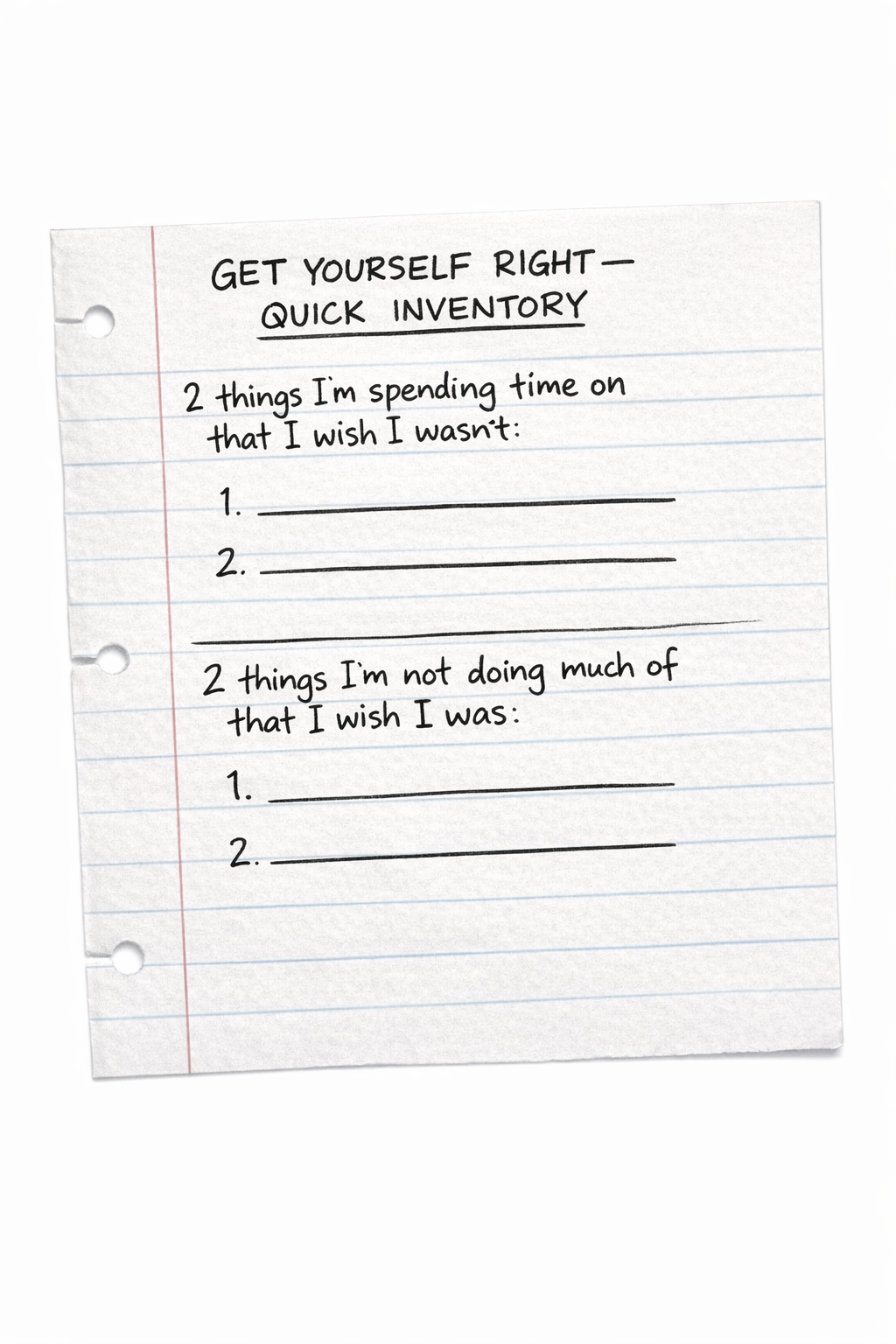
Back to the inventory: I challenge you to physically grab a piece of paper and write down:
Two things you’re spending time on that you wish you weren’t.
Two things you’re not doing much of that you wish you were.
These don’t have to be earth-shattering. They might be things like:
“I’m spending too much time on my phone.”
→ So I’m putting it out of sight from 5:00–7:30.“I need to drink more water.”
→ So I’m making it part of my daily routine.“I’m not being as affectionate as I should be.”
→ So I’m starting with a hug each day—and an ‘I love you’ before bed.“We don’t sit down for meals as a family.”
→ So we’ll commit to at least one sit-down meal per week.
These are small actions—but show me a marriage that doesn’t improve when you intentionally greet your spouse with a hug at the end of the day. Show me a home environment that doesn’t improve when the family sits down for a meal or spends intentional time together.
Here’s the best part: the people around you notice these changes fast. That awareness builds momentum in a hurry.
Being a better spouse, parent, family member, or friend isn’t complicated.
It takes a little planning, a little time, and a commitment to being intentional—one small change at a time.
All is well,
Brennan
